 Garden Notes
This Hawthorn Tea Steeps for Fifteen Minutes. That's One Lap of the Garden Path.
Traditional Medicinals puts a gram of hawthorn leaf and flower in every bag, and a second gram of berry and hibiscus. I read the box, the studies and its side panel while the cup sat covered.

This is a paid advertisement. Sponsored by WorldPantry.com, Inc. (operates the Traditional Medicinals online store); Traditional Medicinals, maker.
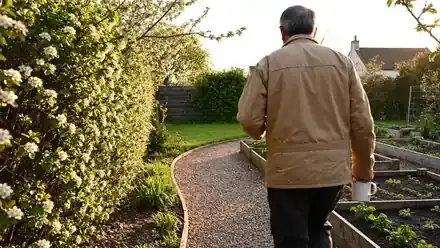
Calvin Mercer is a pen name shared by our writers, and the garden in this story is a composite of the gardens they keep.
The neighbor in it is a composite too, and nothing he says here is a result of the tea.
What this page says about the tea comes from the seller's listing, the panel on the box, the store's return terms and the published sources listed at the bottom.
All of it was read in September 2026.
Behind my house there's a gravel path that loops from the back step, around the vegetable beds, past the shed and back again.
I walk it more times a day than I could count.
Along one side of it grows a hawthorn hedge that came with the house.
Whoever planted it did so long before I arrived, and it's taller than I am now.
Every May the hedge goes white.
The little flowers cover it so thickly that the leaves almost disappear.
Every October it turns red.
The flowers have become small dark-red berries by then, and the birds clear most of them before Thanksgiving.
My neighbor Ambrose grew up in the north of England, and he has never once called it a hawthorn.
To him it's the May tree, because May is the month it flowers.
One loop of gravel, one old hedge, and a neighbor who calls it the May.
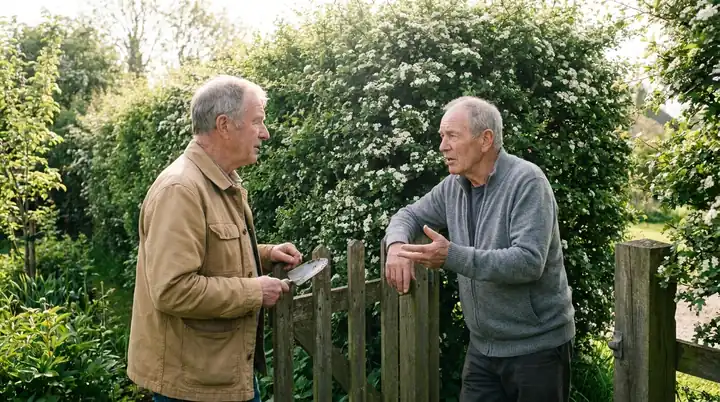
This spring Ambrose leaned over the gate with a small box of tea in his hand.
"Your hedge is on the front of this," he said, and he was right.
There was a sprig of red berries and green leaves on the front of the box, next to a big pinkish-red flower.
I read the back of it standing right there at the gate.
The directions asked for freshly boiled water, a cover on the cup, and ten to fifteen minutes before drinking.
I told Ambrose I don't stand still in a kitchen for fifteen minutes.
Ambrose laughed and said I didn't have to stand anywhere.
"Put a bread plate on it and walk your path," he said.
So that's what I did, the first afternoon.
Kettle on, bag in the mug, a bread plate on top, and out the back door.
One lap of the path, the way I walk it, takes about fifteen minutes.
It isn't the distance; it's the stops, to look at the beans, pull a weed, and see what the birds are doing in the hedge.
When I came back in, the tea had gone a deep reddish amber.
It smelled faintly of fruit, and it was just cool enough to drink.
That's where this page started.
I kept drinking the tea and walking the lap, and I got curious about exactly what was steeping in the kitchen while I was out there.
What's in the bag, and how much of each part? What has each part been studied for, and what does the side panel ask of the man drinking it?
This page is what I found, written out the way I'd explain it to Ambrose over the gate.
It isn't a verdict, and it isn't medical advice.
By the end, you'll know what's in each bag, what the research on it can and can't tell you, and what to ask your pharmacist before the first cup.
You'll also know what a box costs, how long it lasts, and what it asks of your afternoon.
The Hedge That Came With the House
What is hawthorn, exactly? It's a thorny shrub or small tree of the rose family, and it grows in temperate regions all over the world. [1]
If you've ever walked a country lane or the edge of an old field, you've almost certainly passed one.
In England it was planted along field edges for a very long time.
The thorns kept cattle where they belonged, and a trimmed hawthorn grows so thick that it becomes a living fence.
Mine isn't keeping any cattle in.
It keeps the neighbor's cat out of the lettuce, most days, and it gives the sparrows a place to argue.
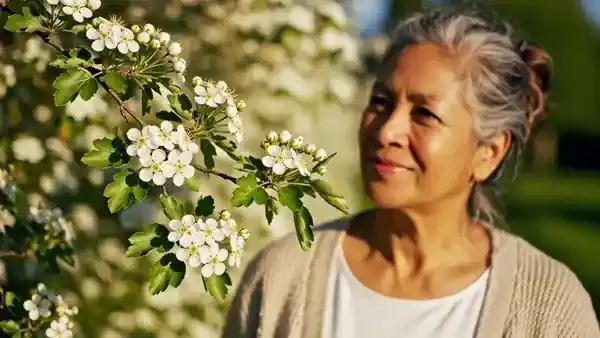
The flowers come in late spring, in flat little clusters of white blooms.
The leaves are small and deeply lobed, a bit like a tiny oak leaf with sharper edges.
Then, as summer turns, the flowers become fruit.
Each one is a small red berry about the size of a pea, and country people have always called them haws.
Do people actually eat them? They have, for a long time.
A review of the plant's chemistry notes that Native American tribes ate the fruit as food, and that hawthorn has a long history as a food in Europe and China. [2]
In China the fruit even has its own name, shanzha.
I've never cooked with the berries from my hedge, but Ambrose says his mother made a jelly from them every fall.
Is there more than one kind of hawthorn? There are a great many, and they don't all have the same chemistry.
The same review says the makeup of the plant varies from one species to the next. [2]
That matters more than it sounds.
It's one reason nobody can say that "hawthorn" does one fixed thing, because the word covers a whole family of shrubs.
Here's the part that matters for the rest of this page.
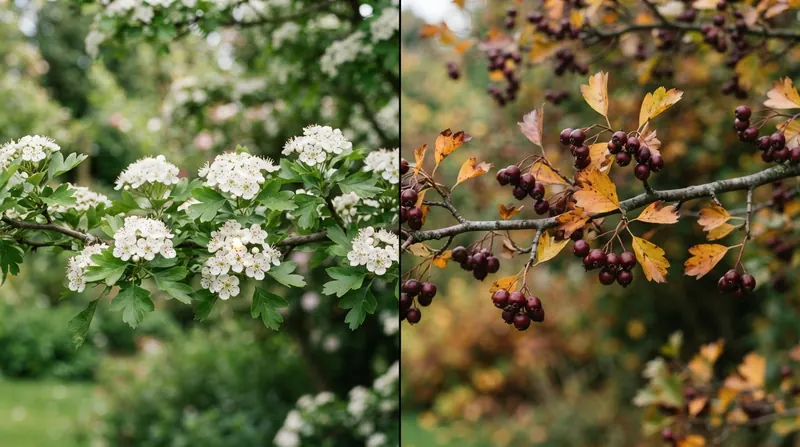
The same hedge gives you two very different crops.
In spring you get leaves and flowers.
In fall you get berries.
They grow on the same branch, but they aren't the same thing.
As you'll see further down, the leaf and the berry are built from different amounts of different compounds, and the box you'll meet later uses both.
Why does hawthorn end up in a tea bag at all? Because it has a long place in the herb books of Europe.
The European Union even keeps an official herbal monograph on hawthorn leaf and flower, with amounts for a cup of tea. [3]
An official monograph sounds impressive, and I want you to hear what it is and what it isn't.
It's a description of how a plant has traditionally been prepared and taken, not a finding that it does something for a particular person.
Tradition is the reason a plant gets studied. It isn't the result.
Keep that sentence in your shirt pocket.
We'll need it again when we get to the research.
The Small Things You Notice on the Hill
Let's talk for a minute about why a man over sixty picks up a box like this in the first place.
It's rarely one big reason.
It's a handful of small ones.
You've probably noticed a few of them yourself.
The hill at the end of your walk feels a little longer than it did at fifty.
The stairs with the laundry basket are stairs you notice now, in a way you didn't used to.
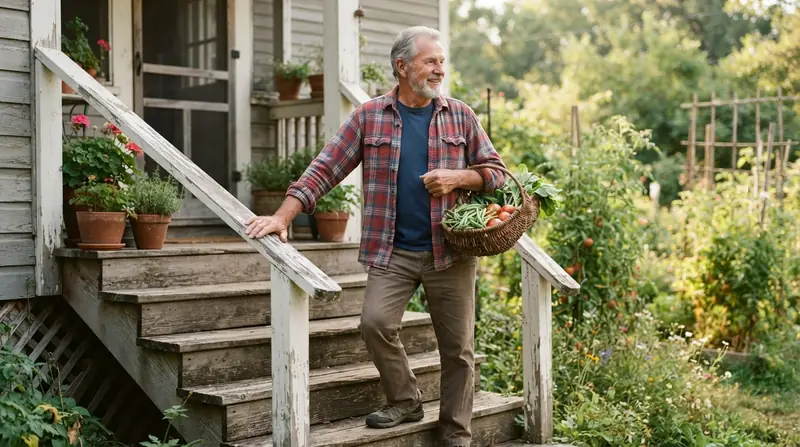
You get home from the grocery store and sit down for a minute before you put the bags away.
Your son walks beside you on the trail and quietly slows his pace to match yours.
You kneel in the garden to thin the carrots, and getting back up takes a little more planning.
You still do all of it; it just asks a bit more of you than it once did.
Should a tea box have an opinion about any of that? No, and this one doesn't.
If something has changed quickly, or it bothers you, that's a conversation for your clinician, not for a box of tea.
So why the interest in the heart and circulation? Because it's the engine under all of it.
Every step up the hill is your heart moving blood out to your legs and back again, all day long, without being asked.
Most men I know don't think about that engine until a birthday with a zero at the end.
Then, quite suddenly, they want to do something.
Not something drastic.
Something small and daily that fits into a morning the way coffee does.
Wanting a small daily habit for the heart and circulation is reasonable. Buying one without reading it first is not.
That's the gap this page is trying to fill.
There are boxes on every grocery shelf with a heart or a red berry on the front, and most of us pick one by the picture.
I'd rather you picked one by the panel.
Or, just as good, decided you don't need one at all, which is where the next section comes close to landing.
What We Already Do for the Heart and Circulation
Before anything new goes in the kitchen cabinet, it's worth counting what's already working.
Most of it doesn't come in a box, and most of it costs nothing.
Does walking count? It counts more than anything else in this article.
The federal activity guidelines set a weekly range of 150 to 300 minutes of moderate activity, such as brisk walking, spread through the week, plus muscle-strengthening on two or more days. [4]
They also say something I wish more people heard.
Some activity is better than none, and moving more and sitting less through the day is part of the advice. [4]

Do short walks count? They do.
The same guidelines say bouts of activity of any length count toward the weekly total, and even climbing a few flights of stairs counts. [5]
That's good news for anyone with a garden.
The trips to the compost pile, the wheelbarrow of mulch, the stairs with the laundry basket: they all go on the tally.
What about 10,000 steps? That number is popular advice, not a guideline. [5]
The guidelines suggest setting a time goal instead, for example adding a 20-minute walk, about 2,000 steps, to a usual day. [5]
I like that example, because it's so ordinary.
Twenty minutes is one lap of my path and a bit more, or once around the block with the dog.
How fast should I walk? Fast enough that you can talk but not sing.
That's the CDC's talk test for moderate activity, and it lists walking briskly at 2.5 miles per hour or faster as moderate. [6]
If you like a number to aim for, here's one more.
In healthy adults aged 61 to 85, a pace of about 100 steps a minute marked the start of moderate intensity. [7]
And for men our age, the guidelines add one thing younger people can skip.
They suggest balance training alongside the walking and the strength work, at an effort set by your own fitness, not a stranger's. [8]
And the plate? The Dietary Guidelines set goals of 3 servings of vegetables and 2 of fruit a day on a 2,000-calorie pattern, eaten whole. [9]
They name olive oil, omega-3-rich seafood, nuts, seeds, olives and avocados among the sources of healthy fats. [9]
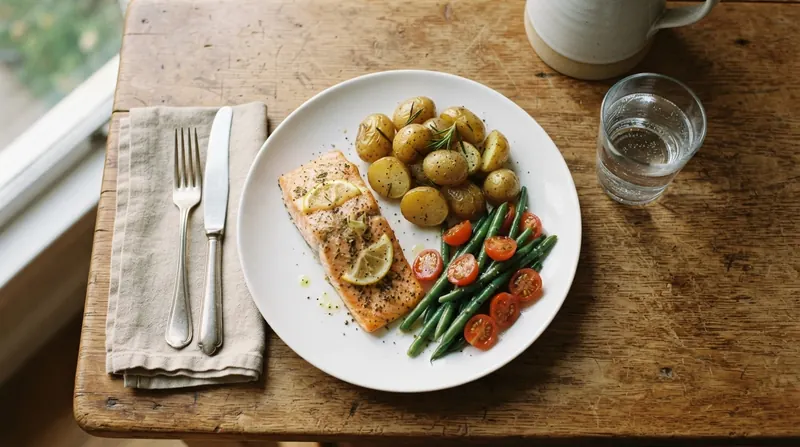
A garden makes some of that easier.
The same federal consumer encyclopedia that covers potassium lists beans, tomatoes, potatoes with the skin, sweet potatoes and winter squash among its food sources. [10]
Those are the crops half the men on my street grow every summer.
The same page advises talking with a provider before taking a potassium supplement, which is one more reason to get it from the beds instead. [10]
What about salt? Most of it never touches the shaker.
The FDA says Americans eat about 3,400 mg of sodium a day against a limit of less than 2,300 mg, and that over 70% of it comes from packaged and prepared foods. [11]
The top sources it names are the ordinary ones: deli-meat sandwiches, pizza, burritos and tacos, soups and savory snacks. [11]
So the practical move is at the label, where 5% of the Daily Value or less per serving is low and 20% or more is high. [11]
And what we drink? Water first.
The current guidelines say to choose water, still or sparkling, and unsweetened drinks, and to avoid sugar-sweetened ones such as sodas, fruit drinks and energy drinks. [12]
They also advise drinking less alcohol for better overall health. [12]
That one I'll leave with you.
Does my morning coffee count against me? The FDA cites 400 mg of caffeine a day, about two to three 12-ounce cups of coffee, as an amount not generally associated with negative effects in most healthy adults. [13]
If you like your morning pot, a box of tea doesn't need to talk you out of it.
And coffee and tea still count toward the water you drink in a day. [14]
A National Academies report on water found that day-to-day drinking driven by thirst, with drinks at meals, keeps hydration normal. [14]
Walk, plate, water, salt. Four habits, and none of them is for sale.
So where does it stop? Honestly, for plenty of men it doesn't stop anywhere.
Those four habits are most of the job, and this page would be doing you a favor if it ended right here.
But I know how it goes.
You do the walking and the plate, and you'd still like one small thing in a cup that feels like it belongs to the heart and circulation part of your week.
That's not foolish.
It's the same reason people keep a vegetable garden when the grocery store sells tomatoes: the doing is part of the point.
Why a Cup Appeals More Than a Capsule
There's something about a warm cup that a capsule can't match.
You make it with your own hands, you wait for it, and you drink it slowly.
A capsule goes down in a second, with a glass of water, standing at the counter.
A cup of tea asks you to sit down, and most of us could use more reasons to sit down with somebody.
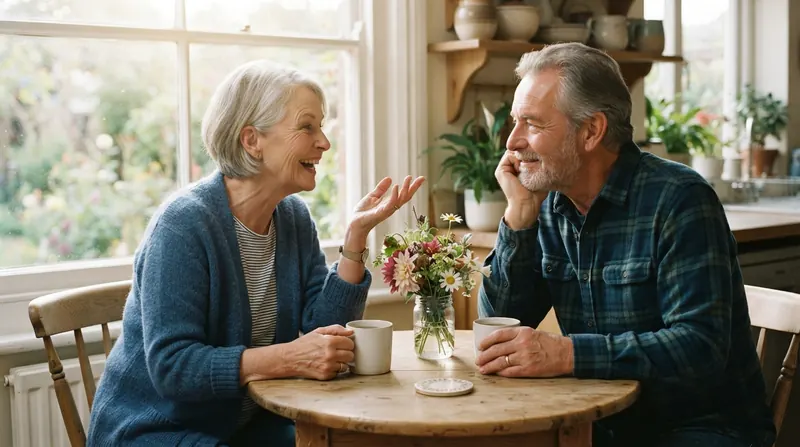
Is the ritual worth anything by itself? It's worth what you make of it.
A cup at three in the afternoon can take the place of a third coffee, a can of soda, or a handful of something from the snack drawer.
That swap is real, and it costs very little.
An unsweetened herbal cup is exactly the kind of drink the guidelines point to, and it counts toward the water you drink in a day. [12] [14]
What about ordinary tea, the black and green kind? Those come from the tea plant, and they have a small, short-term measurement behind them.
A meta-analysis of nine studies found that about two to three cups a day made the arm artery widen a little more easily, and all three of its authors worked for a company that sells tea. [15]
Hawthorn isn't the tea plant, and neither is hibiscus.
So none of that measurement carries over to the box in this story, and I'm not going to pretend it does.
What hawthorn has behind it is different.
It's a long tradition, a well-described chemistry, and a short, honest shelf of research, and we'll go through all three.
Why not just take hawthorn in a capsule? Some people do, and others take it as a liquid extract.
I like the cup, because it's the one form where I can see what I'm drinking, smell it, and taste every part of it.
There's also no guesswork about the dose in a tea bag.
One bag, one cup, and the panel on the side tells you exactly how many grams went in.
That's enough background.
Let's go inside and look at the box Ambrose handed me over the gate.
The Box on the Potting Bench
I keep the box on the potting bench by the back door, next to the seed packets.
It seemed like the right company for it.
Who makes it? Traditional Medicinals, a tea company in Sebastopol, California.
The online store that sells it for them is run by WorldPantry.com, of South San Francisco, and that's the company named at the top of this page.
What does the front say? Mostly what's in it and how it tastes: "Organic Hawthorn & Hibiscus," then "Fruity & Slightly Tart."
Across the middle runs a green band that reads "Promotes Heart Health," followed by a small asterisk.
What's the asterisk for? The box calls itself an herbal supplement, so it carries a Supplement Facts panel rather than a Nutrition Facts panel.
On supplement labels, that little asterisk points to a standard line saying the statement hasn't been evaluated by the Food and Drug Administration.
I like that asterisk more than the band.
It's the label telling you, in its own small print, that a tea box is not the place to look for proof.
What else is printed on it? A line saying there's no caffeine, the words "Daily Herbal" and "Herbal Supplement," the USDA Organic seal, and "16 Wrapped Tea Bags."
The net weight is 1.13 ounces, or 32 grams, which is sixteen bags of two grams each.
That's the whole box on one card, and two grams a bag is the number to remember.
Everything else on this page hangs from it.
The Listing's Own Words, and the Ones I Leave Out
Before the panel, a word about the maker's web page, because you'll probably read it before you order.
It describes the tea as made with "high-quality hand-picked leaves, berries, and flowers," and that part I'm happy to repeat.
The page also uses a few stronger phrases about the heart, and I'm leaving those out on purpose.
A listing isn't a study, and on this page a claim gets a numbered source at the bottom or it stays on the potting bench.
The front of the box is the maker talking. The panel on the side is the box telling you.
Two Grams in Each Bag, and How They Divide
Turn the box over and you'll find the panel.
It's short, which I appreciate: two lines, zero calories, and a note that everything in it is certified organic.
- Organic hawthorn leaf and flower: 1,000 mg in every bag.
- A proprietary blend of organic hawthorn berries and organic hibiscus flower: 1,000 mg, with no split between the two.
- All ingredients certified organic.
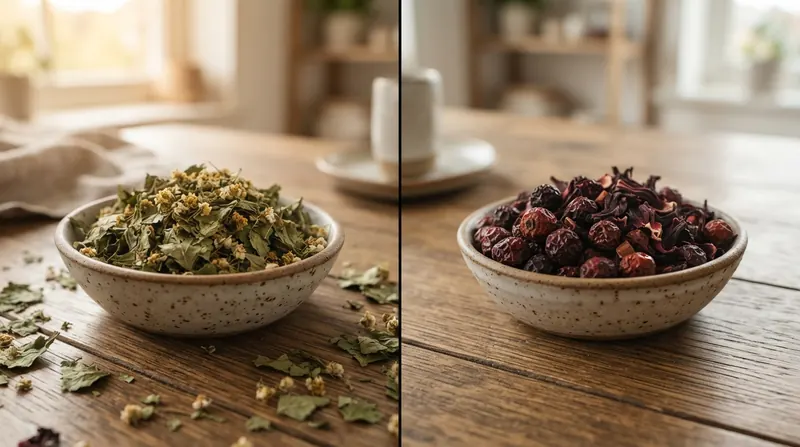
What does "leaf and flower" mean here? It's the dried flowering tips of the hawthorn: the lobed leaves and the small white flowers, cut in spring.
That's the part of the plant described in the European Pharmacopoeia, which asks for at least 1.5% total flavonoids in the dried material. [16]
So the first gram in each bag is the spring crop from a hedge like mine.
It's also the half with the clearest amount on the label: exactly 1,000 milligrams.
And the second gram? That's the fall crop and a tropical flower, mixed together.
Hawthorn berries and hibiscus share one line, 1,000 milligrams between them, and the panel doesn't say how much of each.
Why doesn't it say? A proprietary blend is allowed to list its ingredients and a total weight without splitting them.
It's legal and common, and it's also the one place on this box where you're reading a total instead of an amount.
There's one small clue about the split.
The same maker sells a plain hibiscus tea with 1,260 milligrams of hibiscus in every bag, so the hibiscus in this blend has to be less than that.
Some of the buyers have tasted the same thing in the cup.
One review on the seller's page calls it "light and not overpowering on the hibiscus," and another reviewer expected more tartness than the cup delivered.
So which half is doing the work? That's the honest question, and the label can't answer it.
What I can tell you is what each half is made of, and that turns out to be the most interesting part of the whole box.
One gram you can count. One gram you have to take on trust.
Leaf and Flower in May, Berry in October
Back to the hedge for a minute.
The leaves and the berries grow a few inches apart, but chemically they're not the same at all.
What's in the leaf and flower? The European regulator's assessment report lists flavonoids such as vitexin, hyperoside and quercetin, along with catechin, epicatechin and procyanidins. [16]
Those are plant pigments and tannin-like compounds, from the same broad families you find in many fruits and in ordinary tea.
What's worth remembering is the pattern.
The leaf and flower are where the flavonoids live.
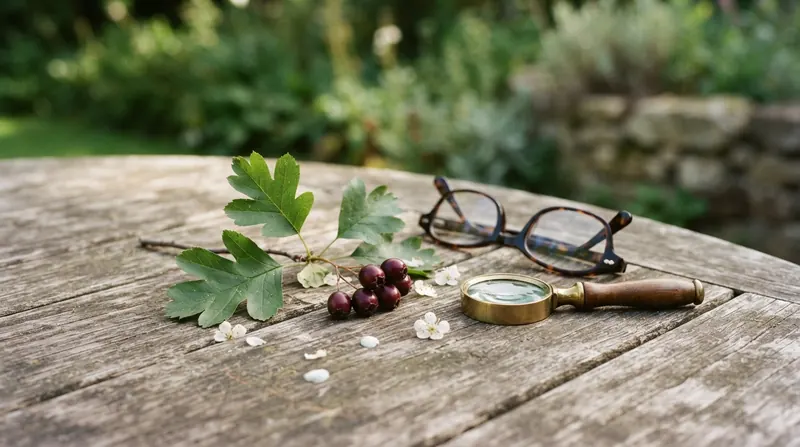
And the berry? It shares some of that, and not the rest.
In a chemical analysis of a North American hawthorn, the leaves held far more hyperoside than the fruit, about 2 to 11 mg per gram against 0.5 to 1 mg. [17]
The leaves in that analysis also held a whole family of vitexin compounds, 2 to 5 mg per gram, that the fruit carried only in traces. [17]
Both the leaves and the fruit held epicatechin and procyanidins at milligrams per gram. [17]
Does ripeness matter? It seems to.
In a European hawthorn, the flowers held the most vitamin C and vitamin E, and the over-ripe fruits held the most sugars. [18]
In the same analysis, the unripe fruits held the most phenolic compounds and the strongest antioxidant activity in laboratory tests. [18]
The berry changes as the fall goes on, from sharp and green to sweet and dark.
So the spring half and the fall half of this box aren't two helpings of the same thing.
They're two different harvests with two different chemistries, and the box gives you a counted amount of one and a shared amount of the other.
Is one half better than the other? Nobody can tell you that from a chemistry table.
These are analyses of the plant, not studies in people, and the species in those analyses isn't necessarily the one in the bag. [17]
What the tables do tell you is why a maker might put both in one cup.
The leaf brings the flavonoids the European books describe, and the berry brings the fruit, the color and the long history as food. [16] [2]
Leaf and flower from the spring, berry from the fall. Each bag is a year of the same hedge.
Ten to Fifteen Minutes With a Plate on Top
Now to the part of the box that started all this: the waiting.
The directions are short, and here they are in plain words.
The label asks for eight ounces of freshly boiled water, poured over one bag.
Then you cover the cup and let it steep for 10 to 15 minutes.
After that, you squeeze the bag, and the label suggests three to four cups a day.
It even gives the squeeze its own little reason: "to ensure maximum goodness."
Why so long? Plenty of tea boxes ask for three to five minutes, and many herbal ones ask for five to ten.
This one asks for up to fifteen, which is the longest on any box in my cupboard.
The label doesn't say why, and I won't invent a reason for it.
But it's easy to believe when you look at what's in the bag: cut leaves, flowers and berries, not fine tea dust.
A dried berry has a skin, and a leaf has a waxy surface.
It seems fair to guess they take longer to give up what's in them than a pinch of black tea, though the box doesn't say so.
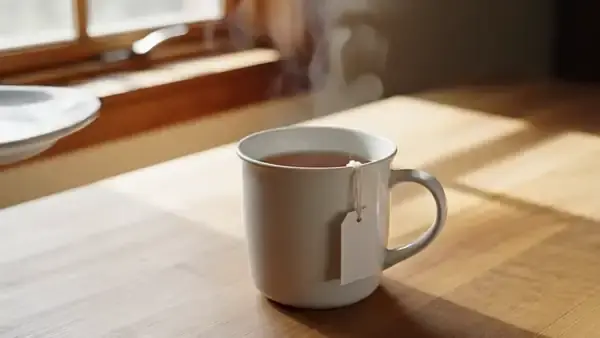
Why cover it? The label just says "Cover," and a bread plate, a pot lid or anything flat will do.
A cover keeps the heat in the cup through the long wait, so the water stays hot while it works on the bag.
How does that compare with the European books? Here's the number I found most useful on this whole page.
The European Union's herbal monograph lists a tea of 1 to 2 grams of the dried leaf and flower in 150 milliliters of boiling water, up to four times a day. [3]
One bag holds 1 gram of leaf and flower, in about 240 milliliters of water.
So each cup sits at the low end of that range, in a bigger cup, and the label's three to four cups a day matches the monograph's "up to four times." [3]
At four cups, you'd be at 4 grams of leaf and flower in a day.
The monograph's ceiling for the tea is 6 grams a day, so the label keeps you under it. [3]
I want to be careful with that comparison.
The monograph describes a traditional way of preparing the plant, and it isn't a study that found the tea does anything for a particular person. [3]
But it does tell you something useful.
The amount in each bag sits in the range the European books give for a cup of this plant, and the directions match their count of cups.
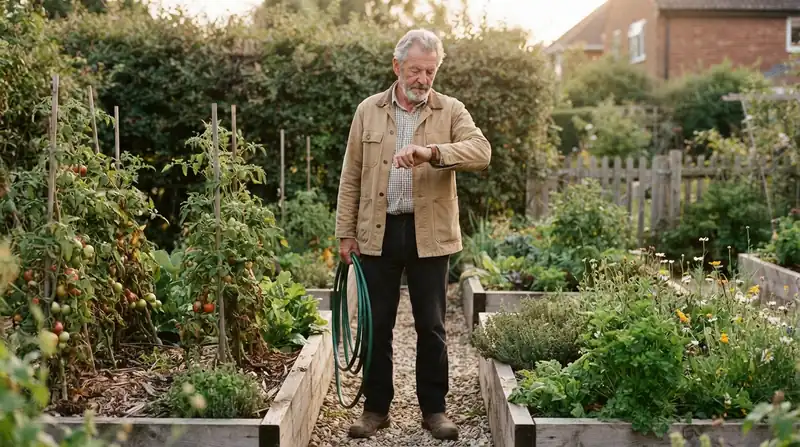
Does the squeeze matter? The label thinks so.
I press the bag against the side of the mug with the back of a spoon, and a surprising amount of dark color comes out at the very end.
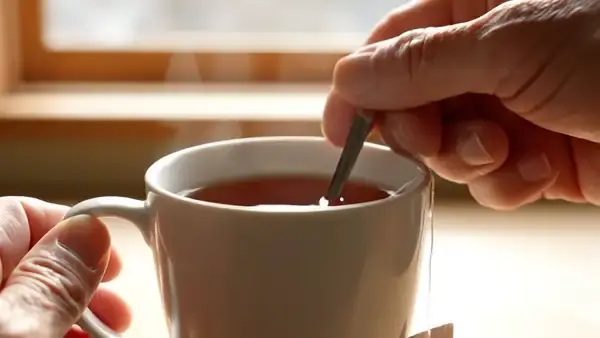
Ten minutes is the label. Fifteen is the label, and the lap in between is yours.
What the Research Says, and Where It Goes Quiet
Here's the section most boxes would rather you skipped.
I think it's the most important one on the page.

What does the federal government say about hawthorn? The National Center for Complementary and Integrative Health says there's little or no quality evidence on hawthorn for most uses. [1]
It adds that no studies have tested hawthorn use beyond 16 weeks. [1]
What does Europe say? The European regulator classes hawthorn leaf and flower as a traditional-use herbal product, based on at least 30 years of use, 15 of them within the European Union. [19]
It found the evidence from clinical trials insufficient and noted a lack of clinical studies. [19]
What about short-term use? The same fact sheet says short-term use of some hawthorn supplements may pose little risk. [1]
That's a careful sentence, and I'm keeping it exactly as careful as they wrote it.
Let me say the whole thing plainly, the way I'd say it to Ambrose.
The long tradition is real, and the proof in people is thin.
Does the body take in much of it? Less than you might hope, as far as anyone knows.
The European assessment report says only a few studies have looked at how the body handles hawthorn's compounds, so it remains largely unknown. [20]
One study it cites measured an oral bioavailability of only 3.57% for vitexin rhamnoside, a flavonoid typical of the leaf. [20]
In cell and rat experiments, the main flavonoids of the leaf crossed the gut lining poorly, with hyperoside doing somewhat better than the rest. [21]
What about blood vessels? There's one laboratory finding worth telling you about, precisely because it's so easy to overstate.
In tests on isolated blood vessels from pigs and rats, two of twenty-one hawthorn compounds widened the vessels, but only at micromolar concentrations. [22]
Human blood typically carries these compounds at tens to low hundreds of nanomoles per liter, far below that. [22]
A micromole is a thousand nanomoles, so the vessels in the dish saw much more than a cup could ever deliver.
That's a vessel in a laboratory dish, not a man on a garden path.
So what's left? A plant with a long place in the kitchen and the herb books, a well-described chemistry, and very few studies in people.
And, importantly, no study of this box: none of the research on this page tested this tea.
I'd rather you heard that from me than found it out later.
If what you want from a cup is a promise, this isn't that cup.
Well described in the lab. Barely studied in people.
Then why drink it at all? Because you like it, because it takes the place of something sweeter, and because the ritual gets you out on the path.
Those are honest reasons, and none of them needs a study.
The Red in the Cup Is the Hibiscus
When you brew a cup, the first thing you'll notice is the color.
It comes out a deep reddish amber, much darker than you'd expect from something with leaves in it.
Where does the color come from? Mostly from the hibiscus.
The part used for tea is the calyx, the fleshy red cup around the seed pod, and its main compounds include two red anthocyanin pigments and organic acids, hibiscus acid among them. [23]
Those acids are where the tartness comes from.
It's why the front of the box says "Fruity & Slightly Tart," and why the cup puts some people in mind of cranberry.
Is hibiscus well tolerated? A 2014 review describes an excellent safety and tolerability record, and it also calls for better controlled trials. [23]
Hibiscus is a food in much of the world, used in hot and cold drinks and as a flavoring. [23]
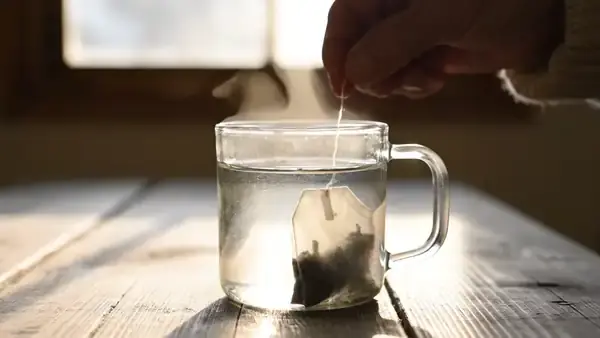
Does much of that red reach the blood? Very little of it, intact.
In six volunteers who drank a hibiscus extract, only about 0.018% of the pigments showed up intact in urine within seven hours, with blood levels peaking about 1.5 hours after drinking. [24]
In another small study of eight volunteers, one serving of a water-based hibiscus extract raised a laboratory measure of the blood's antioxidant capacity compared with water. [25]
That's a marker, measured after a single drink, and it isn't a health outcome. [25]
So in this box, think of the hibiscus as the color and the tartness.
It's part of the second gram, it's less than in the maker's plain hibiscus tea, and it's the reason the cup tastes like fruit.
The Side Panel, Read Out Loud
Every box of tea has a side panel that most people never read.
This one is worth a minute of your time, and I'll tell you what's on it without copying every word.
Who does it ask to check first? Anyone who takes anything daily for the heart or circulation, and anyone who is pregnant or breastfeeding.
It asks them to talk with a healthcare practitioner before the first cup.
The panel is a little more specific than that.
It names one more situation and two kinds of things people take daily, and I'm not going to reprint those words on this page.
You don't need me to.
The box is in your hand, the words are on its side, and your pharmacist can read them in ten seconds.
What should I actually do? Here's the simple version.
If you take anything daily, put it all in one bag with this box, and show it to your pharmacist before your first cup.
Ask two plain questions.
"Is anything here a poor fit at my age?" and "Does anything here argue with this tea?"
Are there side effects? The federal fact sheet says side effects of hawthorn can include dizziness, nausea, vomiting, diarrhea and muscle aches. [1]
It also says little is known about hawthorn during pregnancy or breastfeeding. [1]
The European monograph goes a step further.
It doesn't recommend hawthorn leaf and flower during pregnancy or breastfeeding, or for children. [3]
For the hibiscus, one preliminary study found that 16 days of drinking a hot hibiscus infusion raised the aluminium passed in urine. [26]
Some of the more sensitive volunteers reported mild nausea and dizziness, and the authors advised pregnant women to be cautious with large amounts. [26]
Is there anything to watch for when buying hawthorn in general? One thing, and it isn't this box.
The FDA has warned about several products labeled "tejocote root," sold as a hawthorn root, that actually contained yellow oleander, a toxic plant. [1]
This box names its plant parts plainly: leaf, flower and berry.
That's what you want to see on any hawthorn product, from any maker.
The rule is simple. If you take anything daily, the pharmacist sees the box before you see the cup.
And if something feels off after a cup? Stop drinking it, and mention it to your clinician.
The European monograph asks the same thing: consult a clinician if anything unexpected occurs. [3]
A Normal Day With the Box in the Kitchen
So what does this look like in a real week?
Here's how I fit it in, and you can move the pieces around to suit your own house.
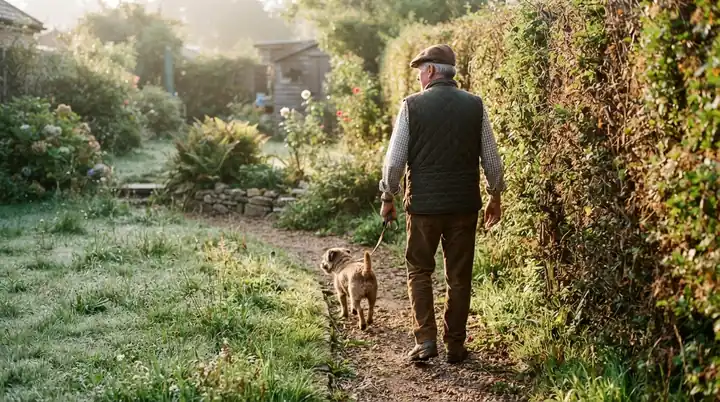
Morning. Coffee first, the way it has always been.
Then the first real walk of the day, twenty minutes around the block with the dog, at a pace where I can talk to him but wouldn't sing. [6]
Mid-morning. The first cup of hawthorn goes on after the garden chores.
Kettle, bag, bread plate, and one lap of the path while it steeps.
Afternoon. This is where the tea earns its place in my kitchen.
Around three, when I used to reach for a third coffee or a can of soda, I make a second cup instead.
After supper. Sometimes a third cup, and sometimes not.
With no caffeine in it, it doesn't compete with anything, and the long steep fits nicely while the dishes dry in the rack.
That's two or three cups on most days, inside the label's three to four.
How long does a box last? Not as long as you might think.
Sixteen bags at the label's three to four cups a day is four to five days.
What does it cost per day? At $7.49 a box when I read the listing, a bag comes to about 47 cents.
Three cups a day comes to about $1.40, or around $42 over a month.
The seller also lists a 3-pack for $20.97 and a 6-pack for $41.94, which brings a bag down to about 44 cents.
Six boxes is 96 bags, a little over a month at three cups a day.
Where can I get it? The seller's online store ships within the 48 contiguous states.
Shipping is at no charge on orders from $45; below that it's $8.95 on orders up to $30 and $9.95 from $30.01 to $45.
The store also lists a $1.49 fuel surcharge.
Alaska and Hawaii cost $15 more, and the store doesn't ship to PO boxes, military addresses or anywhere abroad.
Who Might Enjoy It, and Who Should Pass
Let me be as plain as a seed packet about this.
Here's who I think would enjoy the box, and who should leave it on the shelf.
- You like a warm cup in the afternoon and want one with no caffeine.
- You enjoy fruity, slightly tart flavors, or you've always found straight hibiscus too sharp.
- You already walk and eat well, and you'd like a small daily ritual for the heart and circulation part of your week.
- You like knowing exactly what's in a cup: two plant parts and a flower, organic, zero calories.
- You have ten to fifteen minutes and a garden, a porch or a block to walk while it steeps.
- You want something that changes a reading your clinician takes. No tea box can promise that.
- You take anything daily and haven't shown the box to your pharmacist yet.
- You're pregnant or breastfeeding, or you're buying it for a child.
- You're hoping for a strong hibiscus punch. Several buyers found it mild.
- You want your cup in three minutes. This one asks for ten at the least.
The Fair Objections
Ambrose raised most of these himself, standing at the gate with a cup in his hand.
They're fair questions, so here they are with honest answers.
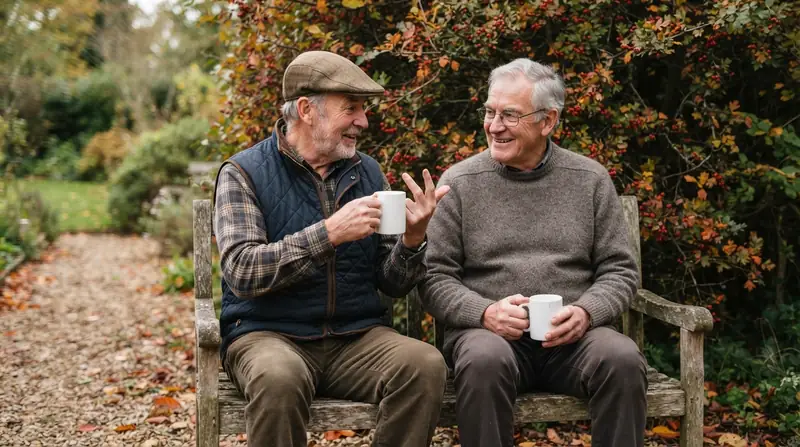
"Isn't fifteen minutes a long time for a cup of tea?" It is.
But you don't have to watch it, and the low end of the label is ten.
Put a plate on it and go do something else.
Walk the path, water the beans or read the sports page, and come back to a cup that's ready and just cool enough to drink.
"At three cups a day, isn't about $1.40 a lot for tea?" It's more than a bag of black tea and less than a coffee-shop drink.
If it takes the place of a daily soda or a third coffee out, it may cost you nothing extra at all.
"What does it actually taste like?" Fruity and lightly tart, by the box and by most of the buyers.
One reviewer calls it "sweet, slightly tangy, berry-ish," and another likes it with a little honey.
If you add honey, count it.
USDA figures list honey at about 82 grams of carbohydrate per 100 grams, with a tablespoon weighing 21 grams. [27]
"Will I feel anything?" I can't tell you that, and neither can the box.
What you'll notice first is the taste, the color and the fifteen minutes on the path, and I'd count those as reasons enough.
If the Box Doesn't Suit You
What if you buy it and don't like it? The store has a satisfaction promise, and it's one of the simpler ones I've read.
WorldPantry.com says that if you're not absolutely satisfied with your purchase, for any reason, you let them know, and they will promptly replace the item or refund its purchase price.
Requests need to reach the store within 90 days, and the shipping charge isn't refunded unless the store made an error.
That covers orders from the maker's online store, not a box you picked up at the grocery.
Is that a reason to buy it? No.
It's a reason not to worry too much about trying one box.
Sixteen bags, ninety days to change your mind, and seven dollars and change at stake.
What the Buyers Wrote
I always read the reviews last, after the panel and the research.
Reviews are the part of the story written in other people's words.
How many reviews are there? The seller's page showed 38 reviews when I read it, averaging 4.84 stars.
Thirty-two were five stars and six were four stars, and a good number of them date from 2015 to 2019.
Were they confirmed buyers? The seller's review system marks each of the seven below as a confirmed purchase.
I've left out reviews that talked about health matters or about things taken daily, and kept the ones about the cup itself.
Here are seven, word for word, including three at four stars.
They're opinions, not evidence, and the small pictures beside them are illustrations, not the reviewers.

This Tea is awesome. Sweet and tart - tastes great with some honey. I've never seen a tea featuring Hawthorne before. The only con is availability at stores. I found it at my local grocery store but haven't seen it anywhere since.

I can't seem to find this in enough stores, but I love the sweet, slightly tangy, berry-ish flavor. My favorite tea!

A friend gave me some of this tea and i am ordering some more. It is light and not overpowering on the hibiscus which is great. It would make a really good iced tea as well!

I love the taste. I am a huge fan of hibiscus and the flavor is delicious and subtle. Good for any time of day.

Purchased several weeks ago and am very satisfied. Good flavor and convenient tea bags. I also like as iced tea.

I was honestly expecting a bit more tartness given my experience with hibiscus, but this tea didn't have as much flavor as I thought. It's still quite delicious, though, and may be what others who normally steer clear of hibiscus products need.

Pleasant taste with healthy properties, but prefer the Hibiscus tea version with the lemon grass.
What do I take from them? Mostly that people buy it for the taste.
Nobody here claims the tea did something for them, and I trust the stack more because of that.
Mariposa's review is the one I'd read twice.
Mariposa expected more tartness, got less, and still called the tea quite delicious, which tells you exactly who this cup is for.
Things Along the Path That Cost Nothing
Before I close, there's a list I keep on the inside cover of the garden notebook.
It's the things that belong in a week for the heart and circulation and don't come in any box.
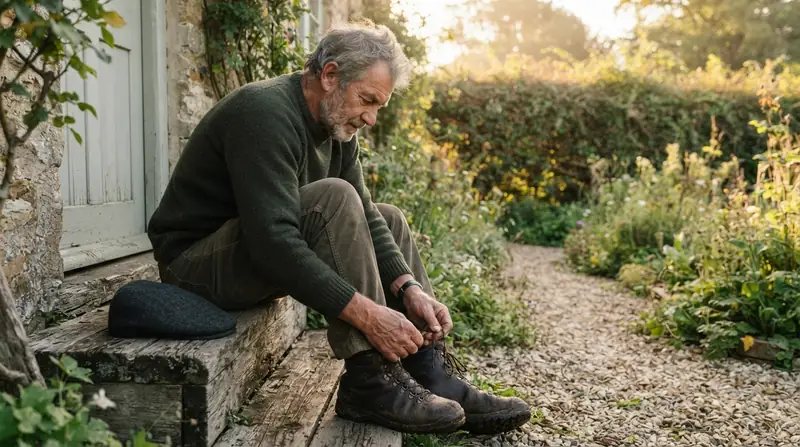
- A weekly total of 150 to 300 minutes of brisk walking or similar, spread through the week. [4]
- Muscle-strengthening on two or more days, [4] and some balance work, at an effort set by your own fitness. [8]
- Walks of any length, including the stairs and the trips to the compost pile. [5]
- A pace where you can talk but not sing; in healthy adults aged 61 to 85, moderate began at about 100 steps a minute. [6] [7]
- Three servings of vegetables and two of fruit a day, eaten whole. [9]
- Beans, tomatoes, potatoes with the skin and winter squash from the beds, for potassium. [10]
- The sodium line on the label, and a day under 2,300 mg. [11]
- Water through the day, with coffee and tea counting toward it. [14]
- Less alcohol, and fewer sugary drinks. [12]
Is the tea on that list? No, and it shouldn't be.
It's a cup that goes alongside the list, never instead of any line on it.
If you only had room for one thing from this page, I'd pick the boots by the back door.
The tea is a pleasant reason to walk the path, and the walking is the part the guidelines count. [4]
The Whole Box on One Seed Packet
If I had to fit all of this on the back of a seed packet for Ambrose, here's what I'd write.
It's everything above, in the order I'd want him to read it.
- What it is: sixteen bags of organic hawthorn and hibiscus tea from Traditional Medicinals, with no caffeine and zero calories.
- Each bag: a gram of hawthorn leaf and flower, plus a gram of hawthorn berry and hibiscus together, unsplit.
- How to make it: freshly boiled water, a cover, 10 to 15 minutes, squeeze the bag, three to four cups a day.
- The European books give 1 to 2 grams of leaf and flower per cup, up to four cups a day. [3]
- The research in people is thin, and none of it tested this box. [1]
- Side effects of hawthorn can include dizziness and nausea, among others. [1]
- If you take anything daily, or if you're pregnant or breastfeeding, the box goes to the pharmacist first.
- Cost: $7.49 a box when I read it, about 47 cents a cup, four to five days at the label's pace.
- If you're not satisfied, the store replaces it or refunds the purchase price; requests within 90 days.
Sixteen bags of hawthorn and hibiscus, one lap of the path apiece
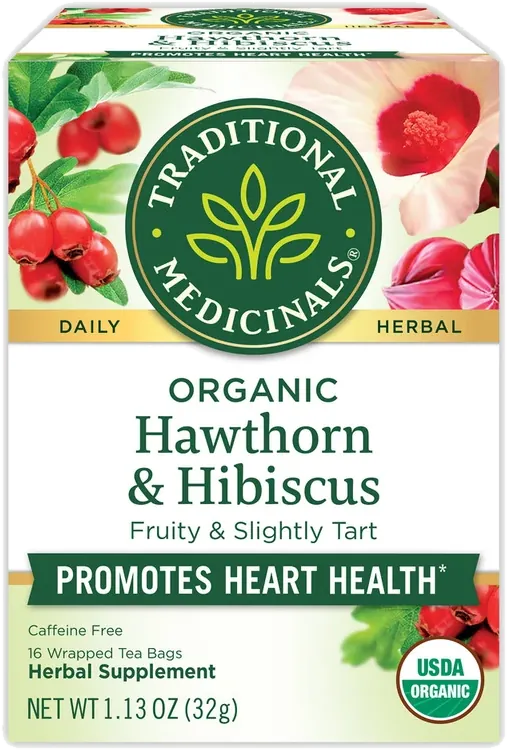
Hawthorn leaf, flower and berry with a little hibiscus in each bag: a fruity, slightly tart cup that asks for ten to fifteen minutes under a lid.
CHECK AVAILABILITYSold by WorldPantry.com, Inc., South San Francisco, California, for Traditional Medicinals of Sebastopol, California · sixteen wrapped bags, covered for 10 to 15 minutes, three to four cups a day · replaced or refunded within 90 days if you're not satisfied
Questions from over the garden gate
Does it have caffeine?
No. The box says it has no caffeine, and neither hawthorn nor hibiscus comes from the tea plant.
How long do I steep it?
Ten to fifteen minutes, covered, in eight ounces of freshly boiled water.
I don't have a lid. Is a plate enough?
Yes. A small bread plate on top works as the cover.
How long does one box last?
Sixteen bags last four to five days at three to four cups a day.
Is the hibiscus strong?
Mild, by most accounts. It shares a 1,000 mg blend with the hawthorn berry.
Does it have sugar or calories?
The panel lists zero calories. Honey or sugar, if you add them, count.
Has this tea been studied?
Not this box. The research is on hawthorn and hibiscus separately, and it's thin in people. [1]
Should I talk to anyone first?
Your pharmacist, if you take anything daily. Your clinician too, if you're pregnant or breastfeeding. [3]
What if I don't like it?
Tell the store within 90 days, and it will replace the box or refund its purchase price.
Back Down the Path
I finished reading the box on a morning at the end of September.
The hedge had started to turn, and the first haws were showing red among the leaves.
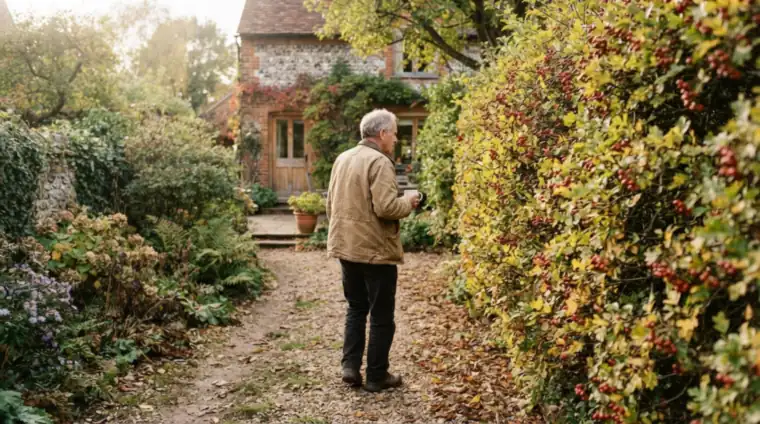
Here's where I landed.
The box is honest about what's in it: a gram of leaf and flower you can count, and a gram of berry and hibiscus you can't split.
The amount in each cup sits in the range the European books give for this plant. [3]
The research in people is thin, and the box itself has never been tested. [1]
Is it worth $7.49 to find out whether you like it? For a lot of men, I think so.
It's an afternoon cup with no caffeine that tastes like fruit, costs less than a coffee out, and gets you out on the path for fifteen minutes.
And if you take anything daily, it's worth a two-minute stop at the pharmacy counter first.
That isn't a formality; it's exactly what the side panel asks of you.
The tea asks for fifteen minutes. The path is happy to take them.
When I told Ambrose all this over the gate, he nodded along until I got to the part about the research.
"So it's a good cup and a good walk," he said, "and nobody's promising anything past that."
That's about right.
If you decide to try a box, you now know what's in each bag, how to make it, and what to ask before the first cup.
If you decide not to, the boots by the back door and the plate of vegetables are still there, and they cost less than any box.
Either way, I hope your path is green this week and your hedge is kind to the birds.
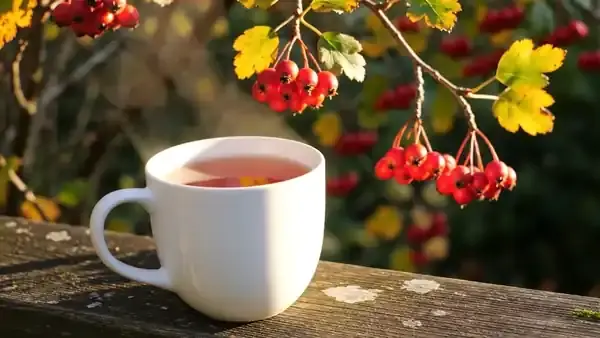
Sold and shipped by WorldPantry.com, Inc. for Traditional Medicinals. The price and any promotion are set by the seller.
Every line of the panel, what each plant part is, and what the research on it measured, is written out in the ingredient and advertising guide linked at the foot of this page.
The guide also explains the side panel's request, and what to bring to the pharmacist.